Payment
20/2/2026

5 min
Agentic Commerce: The AI Payment Guide for Merchants
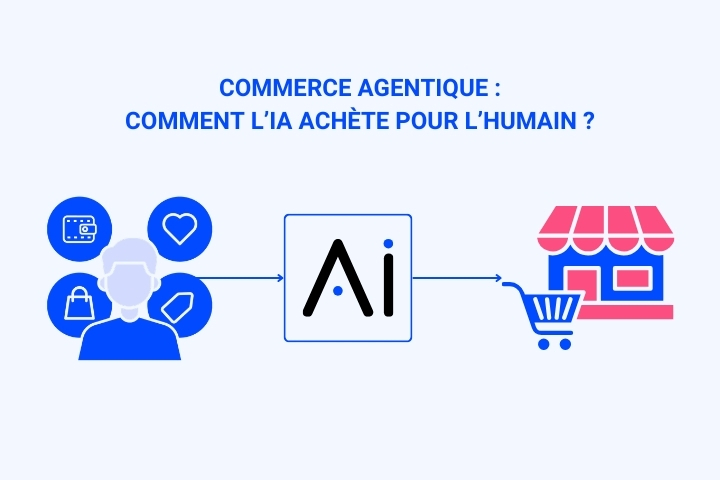

With 78% of consumers having already used AI for their shopping research over the past few months, a radical transformation is taking place in e-commerce. We are entering the era of "Agentic Commerce", where autonomous software makes purchases on behalf of humans. For merchants, the potential is staggering: it is estimated that this market could generate up to $1 trillion in orchestrated revenue in the United States by 2030. But be warned, this paradigm shift requires a complete overhaul of your payment strategy. Is your infrastructure ready to communicate with robots?
E-commerce as we know it is undergoing a profound transformation. We are gradually shifting from a model where humans click on graphical interfaces to interactions driven by protocols, where autonomous agents (AI) communicate directly with merchant systems. This automation promises unprecedented transactional fluidity.
However, a technical gap is widening. Between the emergence of these agents and current standards, merchants risk losing control and visibility over payment data. How can you accept these new automated flows without losing sight of your operations? Here are the keys to adapting your payment orchestration.
Agentic commerce is not just about adding an API to your store. It is about authorizing a whole new form of commercial interaction.
In practical terms, agentic commerce involves AI agents (often advanced conversational models) that act on behalf of a consumer to make a purchase. Unlike a simple recommendation tool, the agent has a mandate: it researches, compares, and decides based on parameters defined by the human (price, ethics, delivery time) and, most importantly, it executes the transaction autonomously.
This is where the technical challenge begins. For the majority of current security infrastructures, an AI agent browsing a site at high speed looks indistinguishable from a malicious "bot" (scraping, fraud attempts).
Historically, merchants have invested heavily to block these bots. In the agentic era, the logic is reversed: you must now be able to distinguish and allow "Trusted Agents" through (Trusted Agents). Without this distinction, you risk blocking legitimate revenue—a particularly critical issue for the ticketing or travel sectors.
To capture this new demand without exposing your site, you can't just wait. You must prepare your infrastructure across four major areas.
Is your site an impenetrable fortress for AI? The first step is identification. This involves implementing mechanisms, often at the network or CDN level (like Cloudflare), to recognize the signature of a legitimate agent and open the door for it.
Once inside, the agent must be able to "read" your catalog. Unlike a human who is sensitive to design, an agent looks for structured data: SKUs, prices, and availability. If this information is inaccessible to code, the agent won't recommend your products. Adopting emerging standards like the Model Context Protocol (MCP) is becoming crucial for standardizing this visibility for AI platforms.
This is often the fatal friction point, as the infrastructure must allow software to order without any human intervention. To succeed, merchants must move away from visual interface optimization in favor of an API-first architecture:
Finally, the critical step: payment. The agent must be able to finalize the purchase using valid credentials provided by the consumer, without going through a traditional input form.
The flow now relies on a series of dialogues between the agent, the merchant, and the payment service provider (PSP). This is where the diversity of payment methods comes into play, as the agent must be able to inject payment data (tokens, virtual cards) directly into the merchant's API flow.
In an agentic commerce flow, interaction no longer follows a linear path. It is structured around a triangular relationship between the Platform (the agent), the Merchant, and the Payment Service Provider (PSP). This model, structured by the Universal Commerce Protocol (UCP), completely redefines the value of transactional data.
There is often a fear that the agent will become a barrier between the merchant and their customer. In reality, thanks to theAgent Payments Protocol (AP2), the opposite occurs: the merchant gains access to raw intent from the buyer.
Contrary to popular belief, using an agent does not make fraud engines "blind." The UCP structure allows for maintaining and even improving risk detection:
Agents can initiate payments through several vectors, each with its own implications:
Given this increasing complexity, trying to "hard-code" every new AI protocol is a risky strategy. This is wherepayment orchestration truly comes into its own.
The reality on the ground will be hybrid: one agent might use Apple Pay for authentication, while another uses an Agentic Token. Merchants cannot bet on a single horse. An orchestration platform like Purse absorbs this heterogeneity. It acts as a hub capable of intelligently routing transactions to the right banking or technology partner, regardless of the data format sent by the agent.
The ultimate goal is to restore visibility. By leveraging a flexible orchestration infrastructure, merchants can better manage the transmission of metadata (the essential four elements: agent ID, user ID, mandate, and credentials). This reconnects payments with customer insights, which is vital for optimizing conversion and securing revenue in a world where your customer is an algorithm.
Agentic commerce is not science fiction: with 92% of AI shopping users reporting satisfaction, adoption is rapid. For merchants, this represents a massive revenue opportunity, provided technical barriers are removed.
Don't let your payment infrastructure become a bottleneck for this new growth. Technical agility will be your greatest asset in turning these bot visits into successful transactions.
Sources