Payment
2/3/2026

2 min
BIN Routing: the lever for balancing your payment costs and performance
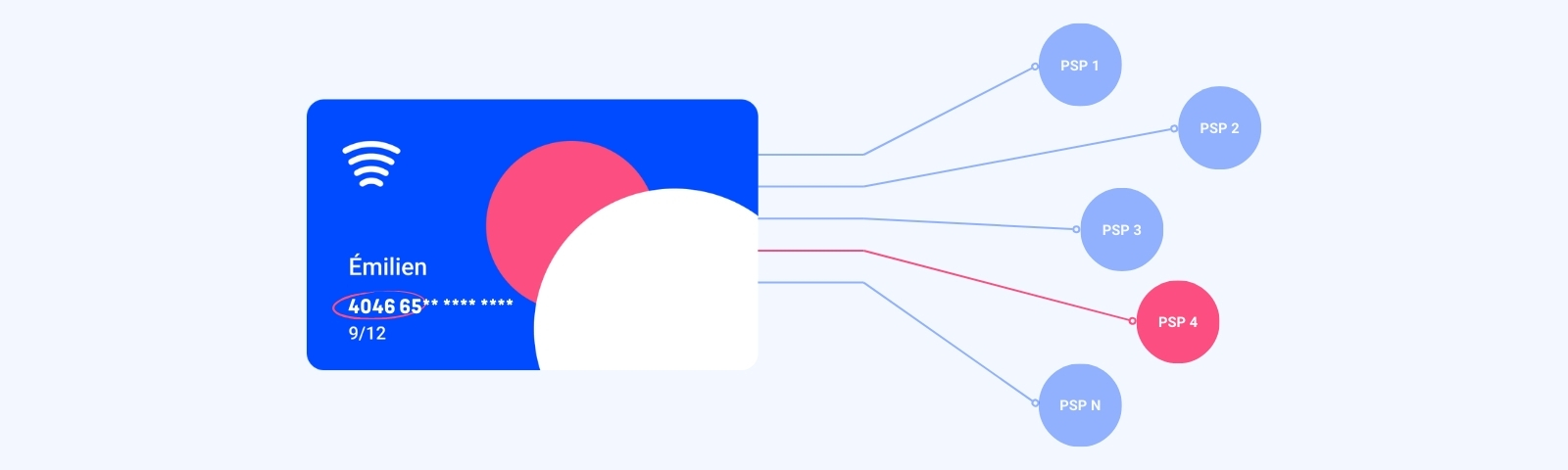

BIN Routing is a native pillar of Purse orchestration, allowing merchants to identify card characteristics to choose the most cost-effective route for every payment.
Today, more than 60% of merchants prefer to work with multiple payment service providers (PSPs) (source). In this context, strategically routing your flows is essential to protect your margins. BIN Routing transforms technical data like the Bank Identification Number, which corresponds to the first 6 to 8 digits of a card, into a powerful decision-making signal to align performance, costs, and user experience.
The principle is simple: as soon as your customer enters the first digits of their card, the system uses the BIN (6 to 8 digits) to trigger the appropriate action. Based on these digits, the merchant can configure their own business rules from their Purse interface.
Unlike static payment behavior, this feature allows you to apply a dynamic strategy: you decide which PSP should process which card type based on your banking agreements and observed performance.
Optimizing commissions is the primary benefit of BIN Routing:
BIN routing ensures a better match between the card and the acquirer, thereby maximizing successful authorizations.
To support your expansion, BIN routing allows you to manage payments based on the card's issuing country.
BIN routing is not just a technical configuration; it allows you to build a true local performance strategy, as illustrated by the synergy between Purse and Payplug in the French market.
For a merchant operating in France, one of the most powerful levers is to isolate cardholders from the BPCE Group. As soon as the customer enters their card number, the orchestrator analyzes the first 6 to 8 digits (the BIN) to instantly identify whether it belongs to this banking group. A business rule then automatically redirects these flows to Payplug, the group's PSP.
This approach is based on the concept of on-us processing (or on-us). Since the card issuer and the acquirer are part of the same ecosystem, the transaction benefits from priority processing.
BIN Routing becomes a business rule that you manage entirely on your own.
By centralizing this logic within the orchestrator, you only need one SDK to manage all your payment flows in an intelligent and optimized way.
Would you like to see how to configure your own routing rules to reduce your costs?