Payment
30/9/2025

4 minutes
NRF Europe 2025: retail and payment trends you can't miss
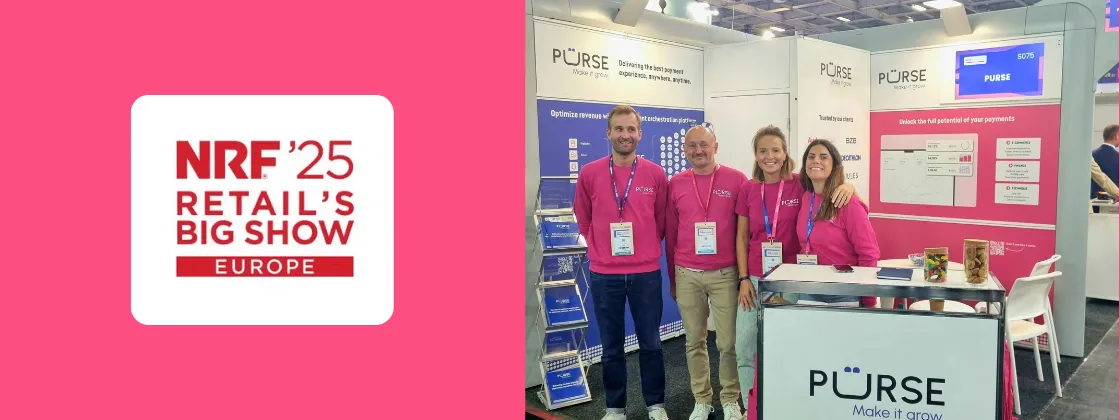

From September 16 to 18, the first edition of NRF Europe was held under the theme “retail together”. A common thread highlighting the need to move forward together to address the sector's shifts: tech players, retailers, and decision-makers.
Following in the footsteps of Paris Retail Week, this event continues to evolve while remaining the essential annual gathering for retail professionals to discover innovations and stay up to date on the trends transforming the industry.
Several underlying dynamics are driving change in retail: the economic, geopolitical, and technological landscape, as well as the growing demands of increasingly savvy consumers.
Since the pandemic, digitalization has become the norm, inflation has pushed brands to optimize their models, and innovation has become an imperative for staying competitive.
To remain attractive, brands are reinventing their models and demonstrating ever-greater resilience, creativity, and operational efficiency.
NRF 2025 Europe was an opportunity for our team to identify the most significant retail trends on the ground.
The wealth of data now available allows brands to gain a deep understanding of their customers and offer ultra-personalized journeys.
Every step of the customer journey provides valuable information: browsing data analysis, email campaign interactions, purchase history, loyalty programs, and more. Leveraging this data, boosted by artificial intelligence tools, enables brands to offer targeted recommendations, individualized offers, tailored content, and even locally contextualized in-store experiences (based on local fashion trends or weather, for example).
The customer feels understood, recognized, and valued. The result: stronger brand loyalty.
In France, 83% of consumers say they are willing to share their data in exchange for a truly personalized experience. This proves that personalization is no longer perceived as intrusive, but as an expectation, provided it delivers value. (source: Fevad)
And what about payments?
This translates into a checkout page aligned with the brand's identity, payment methods tailored to customer preferences, and the recognition of loyal customers without the need for strong authentication, all contributing to a seamless and reassuring experience.
Finally, several conferences addressed the topic of agentic commerce as the culmination of this hyper-personalization of services. These intelligent assistants, capable of knowing a consumer's habits, will take charge of the entire purchasing journey, from product search to payment. A new milestone that could transform customer relationships in retail.
AI was omnipresent at NRF Europe 2025: at the booths, in the conferences, and in the discussions…
The question is no longer whether it will have an impact, but how to integrate it effectively, in the right place, without compromising data security, customer trust, and brand identity.
The most obvious areas of application are:
When used with discernment, AI makes it possible to automate repetitive and time-consuming tasks, gain operational efficiency, and refocus teams on what provides their added value: product expertise, customer advice, and operational excellence.
This is the whole point of augmented retail: a model where technology assists humans to make them better and enrich the daily lives of both customers and employees.
The challenge for retailers is therefore not to replace humans, but to find the right balance between automation and customer relationships.
E-commerce continues to gain ground in France and now accounts for 11% of retail (source: FEVAD report July 2025). As with "in-store" experiences, there are several ways to do e-commerce. Social commerce, which moves the act of purchasing directly into social media platforms, is establishing itself as an additional channel, particularly as a driver in the fashion, beauty, and cultural products sectors.
Major social platforms are developing their own solutions. Instagram and Facebook Shops already offer integrated storefronts, while TikTok Shop, which arrived in France in April 2025, marks a significant acceleration of this trend.
Why is social commerce so successful?
Social media platforms benefit by keeping their users captive from content consumption to transaction, while diversifying their revenue streams. Their reach is hard to match, and the power of their algorithms to target audiences is formidable.
For consumers, the experience is seamless. There is no longer any need to leave their favorite social network to go shopping. They can search, compare, read reviews, be tempted, and make a purchase directly, without being redirected.
As for brands, they may feel somewhat pressured to follow the trend and lose a bit of control over the flow. However, social commerce is becoming a powerful marketing lever that rewards creativity, facilitates the creation of immersive experiences, and fosters engagement. When used well, it strengthens brand loyalty and reaches customers where they are already spending their time.
“How can we create more responsible and sustainable retail?”
This was one of the major themes at NRF Europe 2025. The sessions emphasized the responsibility of retailers and the necessary transformation of business models to meet:
The transition to more sustainable commerce has become non-negotiable. Retailers must reinvent themselves from one end of the chain to the other, across the entire lifecycle of their products.
Through improvements, optimizations, and innovations, everyone is transforming their operations at their own pace to meet the expectations of more sustainable commerce.
Topics addressed at NRF Europe 2025 included product eco-design, logistics optimization, store layout, waste management, and circular economy initiatives.
Regarding transparency, expectations are high, particularly for the fashion industry, which has faced numerous scandals in recent years.
The origin of materials, manufacturing conditions, and social commitments must be communicated clearly.
Initiatives regarding product traceability, such as thedigital product passport, help to strengthen trust and facilitate tracking.
The digital product passport is a type of digital ID card that gathers all relevant information about an item: where the materials come from, how it was manufactured, its environmental impact, and even its recyclability.
Finally, consumers expect authenticity. To remain credible, brands must always ensure their communication aligns with their actual commitments.
And what about payments? Things are moving there, too! Stay tuned for our breakdown of the trends observed at NRF 2025 in a few days.
The first edition of NRF Europe 2025 highlighted the major transformations reshaping retail. The conferences and booths covered a wide range of topics: unified commerce, store design innovation, logistics and supply chain, CSR, marketplaces, payment innovation, CRM, and data utilization.
At the heart of this shifting ecosystem, payments emerged as one of the event's key topics.
The French payment tech scene was particularly visible: over forty players gathered in Hall 4, including 26 booths under thePayment Association pavilion, showcasing their solutions and illustrating the vitality and complementarity of the French ecosystem. A true "payment district" where fintechs, PSPs, banks, and retail solutions crossed paths.
Here are the main 2025 payment trends observed during the event.
Today’s buyer is no longer just an e-commerce or local shopper; they navigate seamlessly between channels. A product might be researched on a smartphone, tried on in-store, and then ordered online for click-and-collect pickup.
Local retail remains vital for expert advice, human connection, and a tangible experience, but it now complements digital habits. The challenge for brands is to ensure total consistency across all channels, conveying the same brand values and guaranteeing a seamless experience.
This requirement also applies to payments. The experience must adapt to this multi-channel journey, yet the reality remains complex. Historically, online and in-store payment providers have been separate entities: they share the same core business—payment acceptance—but operate in different technological environments.
In this context, choosing the right payment partner is crucial for retailers to help them implement fluid, uninterrupted purchasing journeys tailored to their specific needs.
Omnichannel is no longer a competitive advantage; it is a prerequisite. Retailers and payment providers must adapt to this fusion of digital and physical journeys.
Read also: E-commerce: does your current payment solution really meet your customers' expectations?
Increasing autonomy, reducing manual steps, refocusing on the in-store experience, and removing friction... The trend is toward speeding up the checkout process, or even eliminating it entirely.
Contactless payments are now the standard, accounting for over 50% of in-person transactions in France*, which has accelerated the checkout process. Thanks to the integration of new SoftPos technologies, the point of sale is becoming increasingly mobile—whether in the aisles or fitting rooms—allowing customers to pay right where they are. This eliminates the need for fixed checkout counters, sparing customers from queues and preventing cart abandonment for retailers. (*Source )
For example, we attended a conference highlighting the experience of the Norwegian grocery chain Rema 1000, which is similar to the Amazon Go model.
Customers identify themselves via an app at the store entrance, place items in their basket, and then exit by scanning a QR code. Products are recognized automatically, and payment is handled through the app, linked to a saved payment method. A shopping journey with no checkout lines and no product scanning!
Managing security
Managing fluidity in customer journeys: for a seamless experience, the payment stage is often the weak link. How can this step be improved? By making payment increasingly transparent, without compromising security for either merchants or users.
Finding the right balance between enhanced security without falling into overly intrusive and complex processes, while maintaining a fluid and reassuring journey for both the consumer and the merchant.
Digital wallets sit at the intersection of the two challenges mentioned above: facilitating authentication and making payment simple and fast.
They help create a fluid and seamless experience, where payment becomes almost imperceptible to the customer.
Read also: Integrating a new frictionless payment is possible
Their adoption is rapid. At the trade show, Visa and Mastercard invested heavily to highlight their "Click to Pay" solution, promoted right at the event entrance. On the European side, the Wero wallet also held a prominent position and made numerous announcements. Just one year after its launch, it already claims 43.5 million users, including 35 million in France, and brings together 25 banks and acquirers. ( source )
Currently focused on person-to-person (P2P) payments, Wero plans to expand into e-commerce and physical retail by 2026. The rollout will be phased by country, with a launch in Germany announced for late 2025.
Wallets are becoming a strategic tool: they simplify the consumer experience, enhance security, and allow retailers to offer a frictionless payment process.
From identification to the payment stage, Purse is at the heart of this ecosystem. As an orchestrator, we stay on top of developments to provide the integrations that allow our retail clients to create payment journeys tailored to their needs and benefit from the latest innovations, without the complexity.