Payment
12/3/2026

5 min
Payment failures: Save your sales with Smart Retry
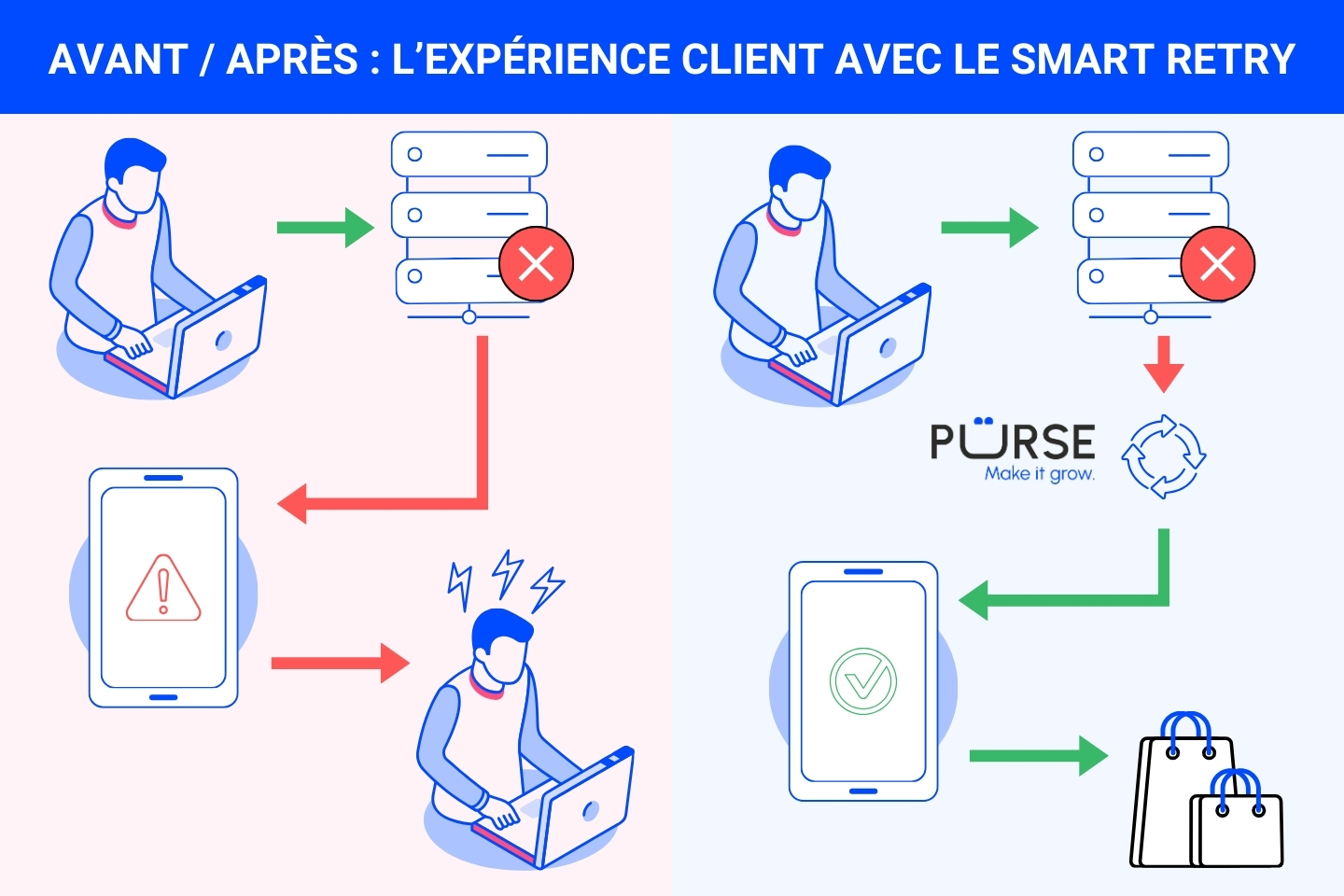

Picture the scene: your customer has browsed your site, confirmed their cart, and is ready to pay. This is the crucial moment. Yet, the transaction fails. Not due to a lack of funds, but because of an unforeseen technical glitch. It’s frustrating for the buyer and costly for the merchant. Fortunately, Smart Retry exists. This payment orchestration feature acts as an authorized, seamless action capable of turning these failures into successes and recovering valuable revenue.
Every visitor who lands on your site represents an opportunity to build a lasting customer relationship. However, in the world of e-commerce, performance sometimes hangs by a thread. As transaction volumes skyrocket and consumer expectations for a smooth experience reach an all-time high, the slightest friction can be fatal.
The Smart Retry (or automatic retry) has become an essential feature for ensuring the resilience of your payment collection.
To optimize your payment strategy, it is essential to understand why a transaction fails. Contrary to popular belief, a failure does not always mean a lack of funds: you must be able to distinguish between a bank's decision and a technical incident.
In banking terms, there are two types of refusals. A "Hard Decline" is a final refusal from the acquirer (stolen card, closed account, critical funding issue) where no further attempts will work. Conversely, a "Soft Decline" refers to a temporary refusal, often linked to a request for additional 3DS authentication after a failed "frictionless" flow.
Important note: Contrary to popular belief, Smart Retry is not used to correct Soft Declines.
The role of Smart Retry lies elsewhere: it acts exclusively on technical incidents, such as latency or timeouts from the banking system or payment processor. It is with this specific type of connectivity error that this feature truly shines, offering an immediate second chance for the transaction to avoid losing a sale due to a simple network issue.
Payment infrastructures are under constant pressure 24/7. During peak periods like Black Friday, sales, or product launches, networks can become saturated. There are many causes for technical failures:
These incidents are often invisible to the naked eye but devastating to your conversion rateIf your system doesn't respond immediately, frustrated customers may abandon their purchase. The average tolerance threshold before frustration sets in is just 6 minutes.
Smart Retry leverages a simple opportunity: if an error is technical and temporary, retrying the transaction a few seconds later is often enough to ensure it goes through.
The automatic retry is an intelligent feature that detects the nature of an error. When a transaction fails for an identifiable technical reason, the system automatically triggers a new attempt. This action is nearly instantaneous and completely invisible to the consumer. They don't need to click again or re-enter their information. The system works for them in the background to validate the payment.
This is where Purse's approach makes all the difference. Thanks to a Multi-PSP architecture (multiple connected providers), you don't put all your eggs in one basket. If your primary PSP experiences a failure or outage, the orchestrator can activate various resilience mechanisms. Smart Retry involves intelligently retrying the transaction—but still on the same PSP, by optimizing timing or submission parameters. If the failure persists, a Fallback mechanism can then route the transaction to another PSP. Finally, in the event of a longer outage, a Backup mode allows you to switch all transactions to a secondary PSP. This redundancy ensures business continuity, regardless of any failures encountered by your providers.
Activating Smart Retry via an orchestration platform isn't just a technical option; it's a major ROI-driven decision.
The financial impact of orchestration is direct, provided you distinguish between each step of the payment flow. Data observed from our clients demonstrates the power of combining these mechanisms:
Overall: This is not an isolated tool, but the combination of all retry mechanisms (Smart Retry, fallback processes, soft decline management, and backup) that generates a revenue increase of between 1 and 1.5%, depending on the robustness of your partner PSPs.
Resilience is your system's ability to withstand disruptions. An average PSP outage lasts about 72 minutes. During that time, without a backup solution, your entire revenue stream evaporates. Smart Retry, coupled with intelligent routing, ensures service continuity optimal. You no longer suffer from your partners' incidents; you bypass them.
The customer experience should never suffer from technical complexity. An effective payment journey must be smooth and seamless. Thanks to automatic retries, you avoid displaying anxiety-inducing error messages to your customers. You reduce friction at the critical checkout moment, which promotes not only immediate conversion but also long-term loyalty. A customer who pays without a hitch is a customer who returns.
At Purse, we put technology at the service of your growth. Our orchestration module transforms failure management into a controlled and high-performance process.
The orchestrator allows you to define your own Smart Retryrules. You can precisely configure:
This flexibility allows you to adapt your strategy in real time, without requiring heavy IT development.
Steering is the key to optimization. Our unified Dashboard centralizes all your payment data, regardless of the number of PSPs connected. You can visualize at a glance:
These Actionable KPIs empower you to negotiate with your providers and continuously refine your strategy to maximize your acceptance rate.
Payments should no longer be a black box or a cost center. With tools like Smart Retry, they become a true driver of performance and resilience. By anticipating technical failures and resolving them automatically, you protect your revenue and provide your customers with the seamless experience they deserve.
Would you like to audit the resilience of your current payment system? Our experts are available to analyze your flows and identify your growth opportunities.