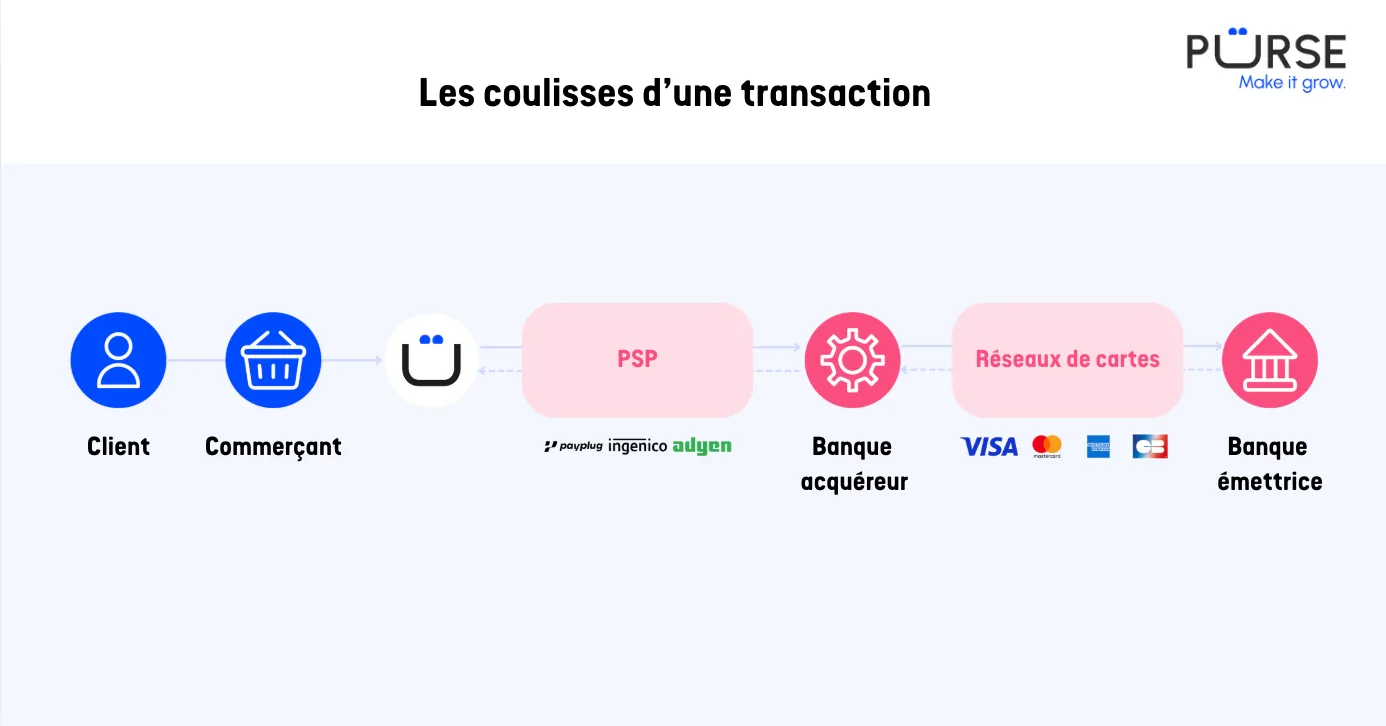
Whether you are shopping online or paying in-store, everything seems to happen in a split second. Yet, behind this simple action lies a complex technical ballet. Several players are involved, each performing a specific role to transmit information, ensure security, and transfer funds. Understanding this process not only helps you better manage your payments but also allows you to identify potential bottlenecks that could impact your sales.
Key players in a transaction
Every payment connects several parties:
The customer : initiates the payment using their bank card, digital wallet, or another payment method.
The merchant or e-retailer : collects the payment via their website, POS terminal, or a secure link.
The PSP (Payment Service Provider) : provides the technical infrastructure that connects the merchant to the banking network.
The acquiring bank : receives the request on behalf of the merchant, transmits it to the payment networks, and credits the merchant's account once the transaction is approved.
Card networks (CB, Visa, Mastercard, etc.): route the request to the issuing bank.
The issuing bank : holds the customer's account and decides whether or not to authorize the payment.
Complementary tools : anti-fraud solutions, payment orchestrators, 3D Secure authentication, etc.
The transaction process, from click to settlement
Initiation The customer confirms their payment online, via an in-store payment terminal, or through a secure link.
Transmission to the PSP The PSP collects the payment data and sends it to the acquiring bank.
Routing to the network The acquiring bank forwards the request to the relevant card network (Visa, Mastercard, etc.).
Verification by the issuing bank It checks the validity of the payment method, the availability of funds, and, if necessary, triggers strong customer authentication (3D Secure, SMS code, biometrics).
Response The issuing bank sends back an approval or a decline, which is relayed back to the merchant through the network, the acquiring bank, and the PSP.
Confirmation to the customer The website or terminal displays the payment result. If the payment is accepted, the merchant can capture the funds immediately or defer this step.
Clearing and settlement The funds are effectively transferred from the customer's account to the merchant's account. Depending on banking terms, this generally takes 1 to 3 business days.
The various possible paths
Not all transactions follow the exact same route.
Without authentication : fast but now rare online, except for certain recurring payments or low-value transactions.
With strong authentication (3D Secure) : enhances security and combats fraud.
With advanced anti-fraud measures : payments are evaluated by a scoring engine before being transmitted.
Multi-PSP orchestration : the transaction is routed to the provider offering the highest acceptance rate.
Smart rerouting : in the event of a decline, the payment is automatically retried via another PSP to save the sale.
Why understanding these steps is strategic for e-commerce merchants
Every link in the payment chain is an opportunity… or a risk. A poorly configured PSP, overly intrusive 3D Secure, or miscalibrated fraud detection can lead to unjustified declines and cause your sales to plummet. By understanding the entire journey, you can:
Identify where payments are failing.
Optimize your success rate.
Improve the customer experience.
Reduce fraud without hurting conversion.
With a payment orchestrator like Purse, you stay in control of every step to maximize your performance.
Sources
Banque de France – Understanding card payments – 2023 – Read